|
|
|
Information
you can use in your business...today! Please visit our website for more information
www.worklinx.co.nz |
Information you can use in your business...today! Please visit our website for more information www.worklinx.co.nz
Also see Malcolm's very readable book: 'Harry's Resigned - there goes half of what we know about everything we do.' www.harrysresigned.co.nz
|
|
 Hi there, Hi there,It seems some organisations like the idea of having ready access to procedures available on the desktop i.e., the computer screen. For this to happen effectively the procedures need to be stored in HTML - web style format - and they have to be pre-sorted in a logical way so people wanting quick access can find the information fast. The good news is, for those who want this access, Worklinx delivers. But, I would offer a note of caution. It is easier for your intellectual capital file to be raided from the HTML environment, than from a secure datafile. However, Worklinx delivers two desktop icon search facilities: 1. The FOLDERS file can be launched this way. It has a very flexible sorting system that provides fast access to procedures by Department. 2. The new 818 Interactive Organisation Chart can be launched there too. This provides click finding for jobs, key tasks and work actions. Great for when a person is away unexpectedly, you can instantly see the implications. Read below for more detail or email for further information. If you would like to see this system in action, give us a call on 021 2749631or e-mail me .. malcolm@mdabusiness.co.nz Regards Malcolm Dennis Managing Director Email Malcolm click here: malcolm@mdabusiness.co.nz |
More on the Worklinx
Interactive jobs chart. Instant key information
|
|
 The
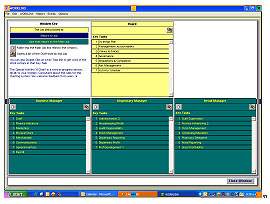
Worklinx Interactive ORGANISATION CHART allows you to view what stsff do from top
down - sideways - and back up again. The
Worklinx Interactive ORGANISATION CHART allows you to view what stsff do from top
down - sideways - and back up again.You click links and see WHAT, WHY and HOW things get done in every job. This know-how mapping system allows you to truly work ON your business ... it is no myth! The WX Know-how Mapping System allows you to DRILL DOWN inside jobs. You select the Key Task line .. click and the Work Actions for the Key Task appear. You can see the full list of Work Actions and which have Procedures entered. Then you can open the Work Action and Print. This system shows you WHAT, WHY and HOW jobs get done. It also has the potential to show you why things stuff up because you can see where correct procedures HAVE NOT been written for an action. So you can see what has been done and what hasn't .. that can be very helpful - cost effective .. saving money and time .. really dealing with wastage. Imagine drilling down to any job in your business - to reveal what has and hasn't been documented. This enhancement is available with the latest UPDATE. The update is free for WX Users on Service Fee. Price on application for others. Contact Malcolm on Ph 021 2749631 or at malcolm@mdabusiness.co.nz Return to TOP |
|
|
I am not convinced many owners of SMEs implement a formal board structure
for their business. That's understandable, because to some extent it would be a meeting
with themselves. However, it can be helpful to review the role of a director and
maybe wear this hat from time to time to make sure you have reasonable comfort on
these activities - responsibilities, obligations and liabilities.
This list shows the Key Tasks and linked Work Actions of the Board. This may be
a helpful stimulator for your own ideas. If you would like to take this further and
find out how I have mapped the Work Actions ... the next level down in Worklinx ...
please give me a call on 0800 496755 or e-mail malcolm@worklinx.co.nz |
|
 ...
a story from my book: Harry's Resigned - there goes half of what we know about
everything we do. by Malcolm Dennis. ...
a story from my book: Harry's Resigned - there goes half of what we know about
everything we do. by Malcolm Dennis.To minimise the risk when Harry resigns, there are three golden rules: [NB Harry may be male or female!] 1 Keep Harry happy. Pay well and keep your benefits above average. (Do a good deal with KiwiSaver.) Make sure continuing education matches Harry's role and his (her) personal development needs are fulfilled. If in the long run it makes sense to invite Harry to be an owner, then that will be better than the alternative. Take the better option. 2 Have a watertight employment agreement. If it is too easy to leave, Harry may go on a whim. However, if departing could cause legal issues, then Harry may have second thoughts and decide it won't be so green in the next pasture. The quality of your employment agreement could be the decider, so get it right from the beginning. Employment agreements are an important part of the employment process. Invest in quality documents that enhance your employment management. You may not be able to stop Harry from leaving and starting in business, but with appropriate legal safeguards, you can limit the consequences for your business. 3 Clone the job before they go. There is no point having an unhappy and probably disruptive person on your team. Make it a rule, a requirement, that ALL jobs in your business are fully documented. Then, when a Harry resigns, you can be confident your business - your customers - will survive. MORE Harry's Resigned stories. Order a copy of the book ... Click Here. Return to TOP |
|
| Customers and Prospects are Different When it comes to advertising, promotions and PR (public relations), it's important to make a distinction between customers and prospects. And it's also important to make a distinction between casual customers and those higher up the loyalty ladder - especially customers who have become advocates for your business. While there are many variations on what falls into the promotions category, for the purposes of this article, I will focus on two - advertising and PR. Broadly speaking, advertising is used to generate NEW business - prospects, whereas PR is designed to communicate with your existing customers. Regarding advertising, the most important thing to consider is your offer. Customers want to know WIIFM - what's in it for me? That usually means the advertisement has to be BIG enough or long enough (radio & TV) to get attention, make your offer and motivate people to buy. If the advertising is simply designed to promote your brand, make sure your logo and key slogans are prominent. But, maybe you should question this expenditure altogether. Does random brand advertising really pay? Focussed customer loyalty programmes generally do better. After all, the bulk of all sales come from repeat business and referrals, so that's where you should make your continuing investment. A great deal of advertising is wasteful because the audience is not refined and therefore many people who see or hear the advertising are not even prospects. But if the ad is powerful enough - the offer is great - then people may be motivated to respond and purchase and become a customer. Then what? Your mission has to be to gather ALL the information possible about your customers so you can talk to them often about satisfying MORE of their needs. They will climb your loyalty programme ladder. The more they buy, the more attention you should give them. Well that's the theory, but so many businesses do this poorly. Nowadays, there is no excuse, data files are really easy to create and manage. Data files containing heaps of information on both customers and prospects. Now let's look at PR. When you have created a customer data file, you need to look at ways to communicate with these 'friends.' An excellent and very economical way is to use an electronic newsletter. In other words, an email newsletter. These are not hard to create any more and they are very effective. But, there are a few traps to avoid. Customers don't like to be spammed - sent unauthorised mail. However, if they know who the email has come from - your business name is obvious - they will generally be happy to receive it BECAUSE, they like what's going on - they BUY from you. But, if they are only a prospect - they may not like you treating them as a sounding board. So, you need to make a VERY clear distinction between how you communicate with customers and prospects. You can be chatty and familiar with customers, but with prospects, you still need to win them! Because your email newsletter should primarily be sent to customers - the newsletter should not be an advertisement. If you want to 'sell' to your customers, promote using direct marketing techniques. But don't use your newsletter as the medium. Here's some newsletter rules: Have a master list of topics: common questions or issues your customers ask and general information that will help them make or save money or time. Think short: the shorter and punchier the better. Have a single focus for each newsletter. Don't sell: Announce new products and services, but tell - not sell! Write as if you are talking to them: be relaxed, informative, and friendly. Build relationships. Be consistent and regular: customers like frequency, don’t let them down. They want to be 'in the know!' Offer a removal service: the option to be removed from your list. Clear contact numbers: ALL your contact points are clear; telephone number, email and website. Make them personal. All your names etc. malcolm@mdabusiness.co.nz Return to TOP |
|
Sub title : 'There goes half of what we know about everything we do!' |
|
|
|
|||||||
|
|||||||
|
|
 Greetings
 In this issue
